
SOLUTIONS
Perfect Your Thermofoil Prep With Automated Sanding
A controlled, perfectly consistent approach to surface preparation.
The True Cost of Avoiding Manual Sanding In Thermofoil Prep
hermofoil demands perfection, and manual sanding is a high-stakes bottleneck where one slip-up ruins a part. To avoid this, many shops rely on gluing inserts into cavities, a workaround that requires machining two parts, double inventory, and manual assembly.
This process is your current “normal,” but it’s keeping your cost per door 80% higher than it needs to be. By automating your sanding process, you can skip the inserts entirely and drastically drive down your manufacturing costs.
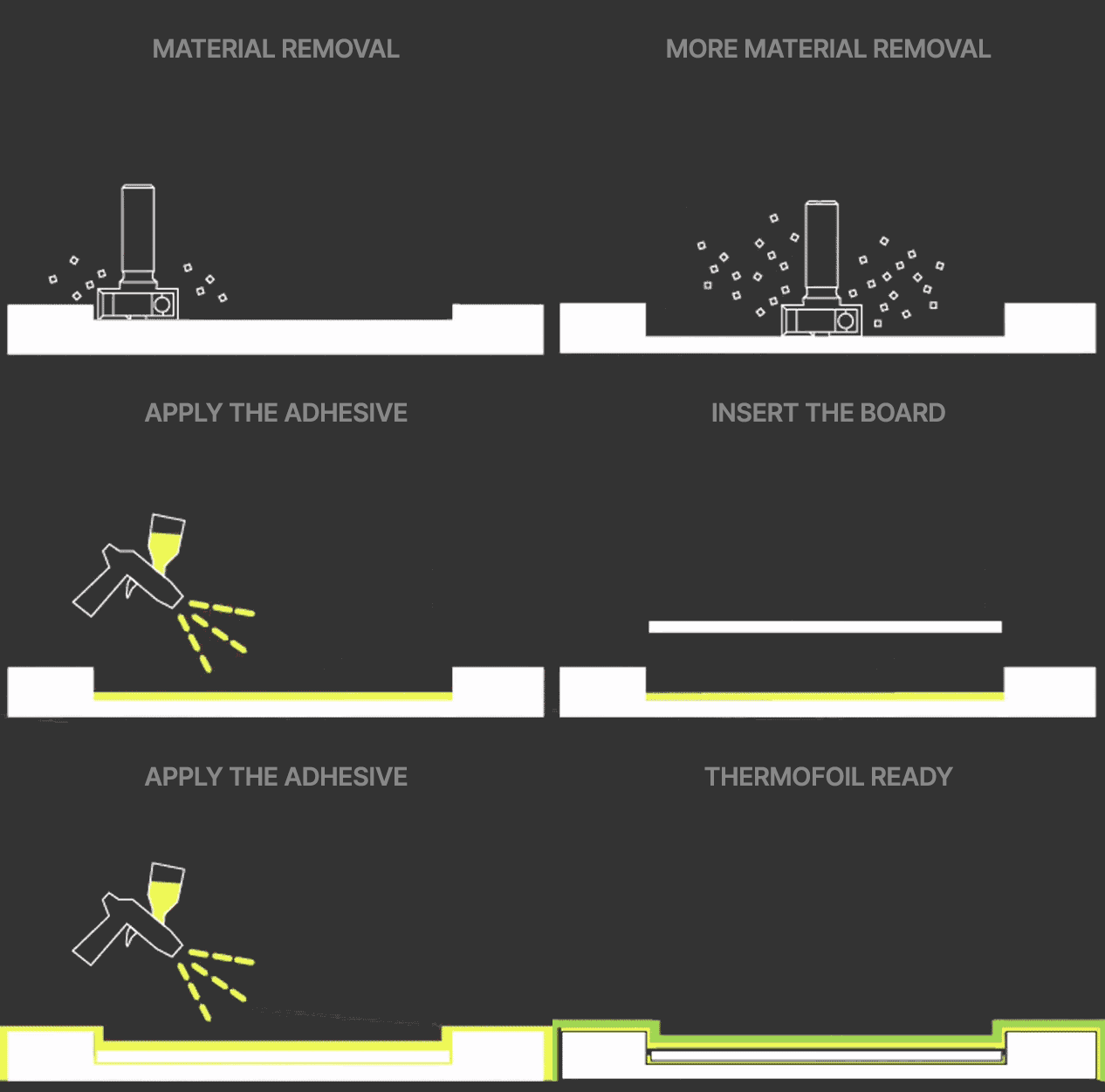
This traditional two-part insert method requires double the machining, manual gluing, and endless waiting, driving up costs by 80%. Skip this entire sequence and machine a flawless, thermofoil-ready door in just one pass.
The Challenge of Thermofoil Perfection
Thermofoil production leaves no room for error. Because the vacuum-pressing process is so sensitive, even minor process variations, machining fluctuations, inconsistent sanding, or improper abrasive grits, will “telegraph” through the finish and ruin the final product.
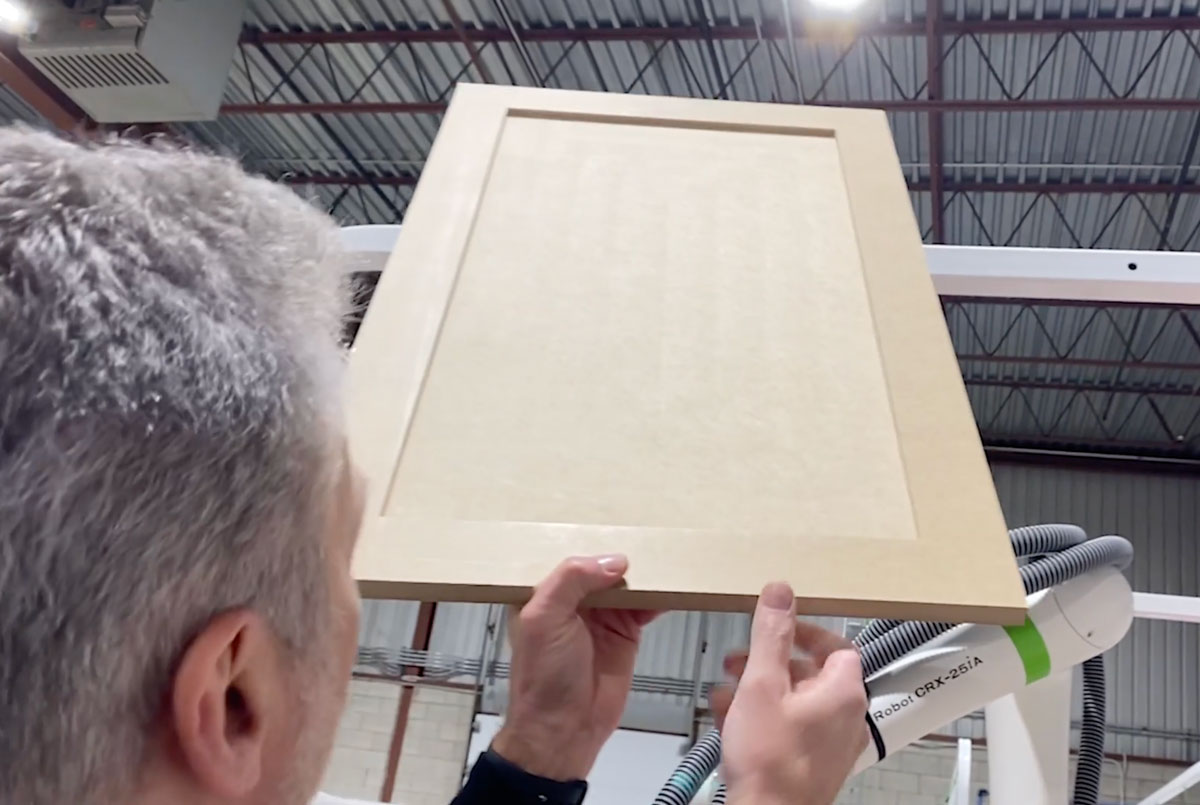
Common production hurdles include:
Persistent Tool Marks
Visible patterns that fluctuate based on tool wear and material density.
Inconsistent Sanding Patterns
Abrasive tracks that compromise the smooth, high-end look of the foil.
Surface Irregularity
The struggle to maintain perfect flatness across the entire part during the sanding cycle.
To avoid these risks, many manufacturers resort to the costly practice of machining and gluing separate inserts. While this bypasses the sanding challenge, it significantly inflates the cost per door and complicates your workflow.
The PSA-80 Pro changes the math. It delivers the precise, scalable sanding required for thermofoiled shaker doors in a single pass.
Why Autonomous Systems Fit the Thermofoil Workflow
Traditional robotic sanding systems often lack the precision and force-consistency required for flawless thermofoil finishes. If a door is even slightly misaligned, a standard robot applies uneven pressure, instantly creating defects on the delicate surface.
The PSA-80 Pro operates on a fundamentally different level. By integrating Automatic Pitch Control (APC) with Active Force Compensation (AFC), it eliminates the margin for error:
Precision Detection
The system automatically identifies the exact position, size, and orientation of every part with 0.1 mm accuracy.
Real-Time Adaptation
It adjusts the sanding path in milliseconds, ensuring the abrasive is always at the optimal angle.
Constant Force
Regardless of part placement, the machine maintains perfectly consistent pressure across the entire surface.
Manual Sanding
Traditional Robotic
Industry Leader
Omnirobotic
3D AI & Force Control
Surface Sensitivity
Relies entirely on operator skill
Controlled by rigid programming
Controlled by active, adaptive force
Consistency
Operator-dependent
Varying depending on part position and flatness variation.
High, regardless of part position and deformation
Setup & Programming
None
Medium (Required declaring the type of part)
Zero (Self determine the type of part)
Labor Dependency
High
Medium (Operator is responsible for part positioning and correct type identification)
Low (True walkaway autonomy)
What Changes in Your Production?
When you automate thermofoil preparation with Omnirobotic, the primary advantage isn’t just lower overhead, it’s absolute repeatability. By removing the variables of human error and complex workarounds, you achieve a level of quality that is identical from the first door to the last.
Eliminate Rework
Stop losing margins to manual sanding defects and "telegraphing" lines.
Streamline Your Shop
Erase the logistical nightmare of tracking, machining, and gluing multi-piece inserts.
Slash Production Costs
Realize immediate savings by reducing machining time, material waste, and the labor-intensive assembly required for traditional insert methods.
Stop Overpaying for Workarounds and Start Scaling With the Industry's Most Efficient Finish.
Tell us what you’re sanding, and we’ll show you how the PSA-80 PRO gets it done.
Autonomous Robots.
Trusted by Industry Leaders.

Resources
Contact Us
- © Omnirobotic Inc. 2026