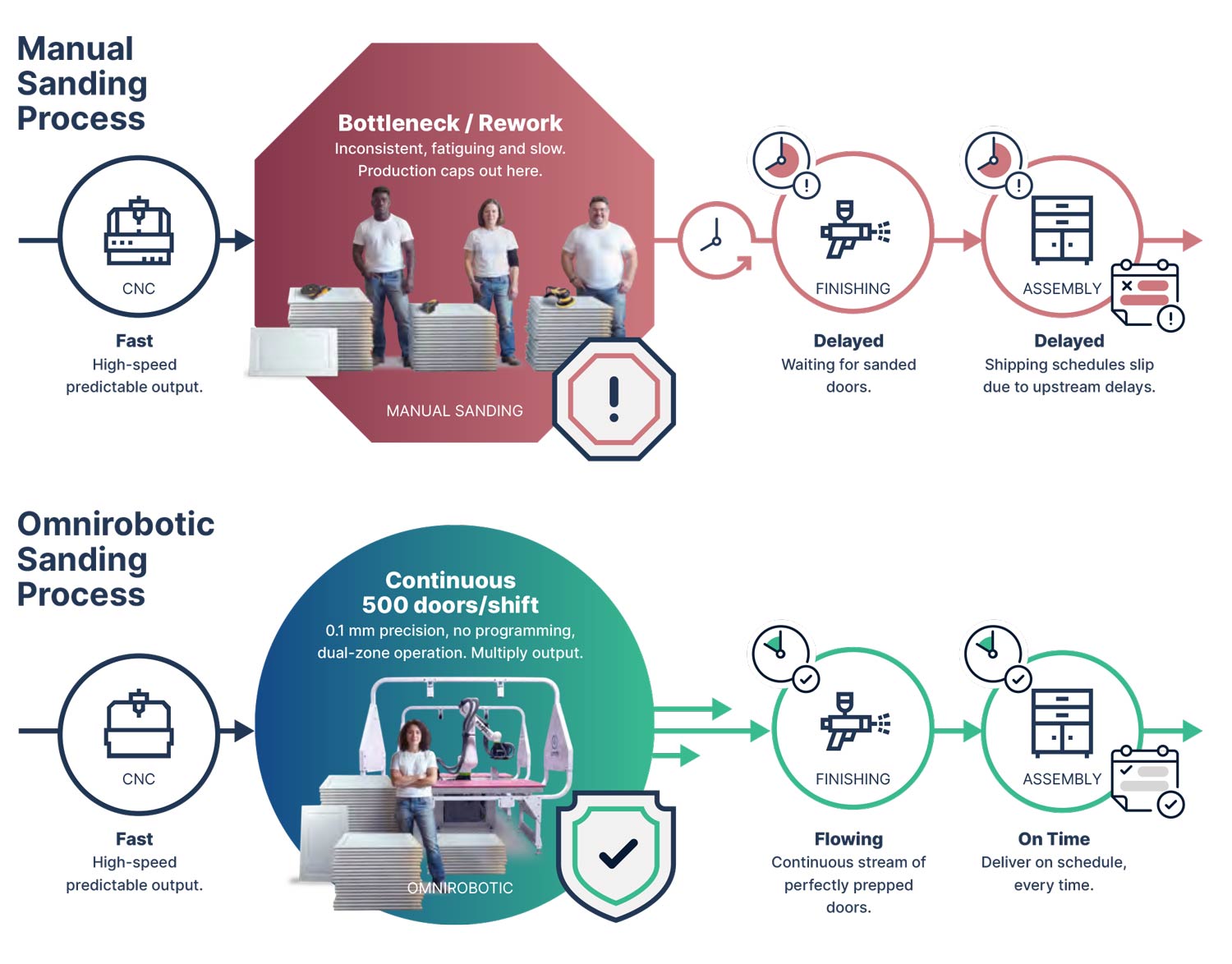
In theory, sanding is simple. In a high-mix production environment, it is chaos.
Cabinet manufacturers don’t just run identical parts all day. You deal with a constant flow of:
Mixed door styles (Shaker, slab, raised panel)
Varying sizes and complex edge profiles
Different materials (MDF, hardwood, primer…)
Strict, uncompromising finishing requirements
Manual sanding struggles to stay consistent across these variations, especially on Friday PM.
However, traditional robotic systems just introduce new constraints. They require strict batch sorting, rigid programming “recipes,” and high operator dependency. If a robot forces your worker to sort parts and stand at a touchscreen all day, it hasn’t solved the bottleneck; it simply moved it.
“Hand sanding is the least enjoyable job in cabinet making.”
— Ryan Barbiaux
Vice President at Cabinet Creations and Design
What True Cabinet Automation Actually Solves
Automation is an investment in workflow, not just overhead.
A truly profitable system doesn’t just replace human hands; it fundamentally transforms how parts move through your factory.
A modern system must:
Handle massive part variation without constant setup or software tweaking.
Deliver a consistent quality across shifts and materials.
Drastically reduce dependency on skilled manual labor.
Keep production flowing without stop-and-go interruptions.
Choosing the Right Approach for Your Shop
What sanding model actually fits a high-mix cabinet shop?
When evaluating your options, you must look at how the machine impacts your total workflow, not just the speed of the sanding head.
Manual Sanding
Traditional Robotic
Industry Leader
Omnirobotic
3D AI & Force Control
Changeover & Setup
Operator-managed every time
Requires constant jigs repositioning, part alignment and sometime software parameters changes
Zero Setup .Real-time 3D scanning adapts instantly to multiple parts
High-Mix Production
Flexible, but incredibly slow
Extremely rigid and inefficient
Designed for it. Mix shakers, slabs, face frames, and sizes freely.
Labor Dependency
100% manual reliance
High (Operator acts as machine attendant)
Low (20 minutes of walkaway autonomy)
Workflow Impact
Slows flow between CNC and finishing.
Improves speed, but adds setup constraints, as highly depend on operator response time.
Optimized Flow. Continuous pendulum production, independent of operator response time.
Best Shop Fit
Small, custom artistic pieces.
Low volume, single piece raw mdf shaker door.
Real-world cabinet production (MDF, Paint Grade and Stain Grade Hardwood)
What Changes in Your Daily Operation?
Multiply Output. Not Headcount.
Beyond the perfect surface finish, the real ROI of sanding automation appears in your daily workflow. When you install an Omnirobotic system, your shop floor dynamics change entirely:
Continuous Production Flow
Our pendulum system means parts move from machining, to sanding, to finishing without stop-and-go loading interruptions.
Reduced Sorting and Handling
Because the AI maps the wood on the fly, operators can process entirely mixed batches without separating them by size or style.
True Labor Reallocation
Instead of babysitting a machine, operators get hours of their day back to shift to higher-margin tasks like final assembly or quality control.
When sanding becomes predictable, throughput stabilizes, rework plummets, and scaling your business finally becomes possible.
Take Your Sanding Process to the Next Level
Tell us what you’re sanding, and we’ll show you how the PSA-80 PRO gets it done.