
SOLUTIONS
Cabinet Door Sanding Automation
Mastering Shaker, Raised Panel, Face Frames and Slabs in High-Mix Production
The Real Problem in Cabinet Sanding
Remove CNC tool marks. Protect delicate profiles. Eliminate batch sorting and rigid programming.
In a custom cabinet shop, door sanding is never repetitive. Your daily production is a constant, unpredictable mix of shaker doors, raised panels, slabs doors and face frames.
Keeping your finish quality consistent across that level of variation is one of the hardest challenges in manufacturing. If your automation requires you to sort parts by size or style and program a recipe for every new batch, it hasn’t solved your labor bottleneck, it has just slowed down your workflow. To truly scale, you need a system built for the high-mix reality of the cabinet floor.
Why Cabinet Doors Are Uniquely Difficult to Automate
A cabinet door is a complex combination of broad flat surfaces, crisp inside edges, sloping raised panels, and delicate profile transitions.
When trying to automate this process, traditional systems are forced to make a compromise. Because they rely on rigid, pre-programmed paths and cannot account for depth variation, they usually fail in one of two ways:
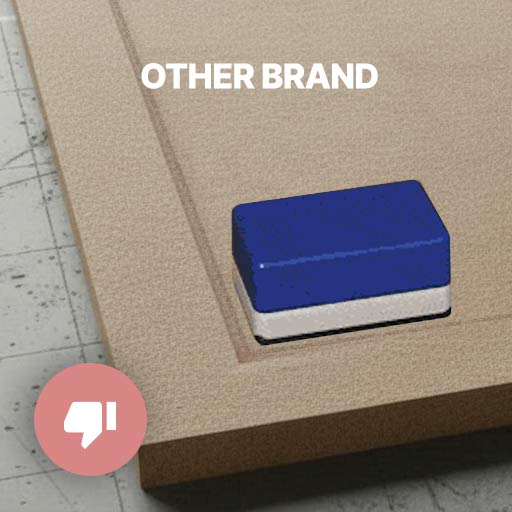
They avoid the edges and slopes
To prevent damaging the inside profile, the robot must stay 5 to 6 mm away from the inside edge, leaving deep CNC tool marks that require a manual touch-up team.
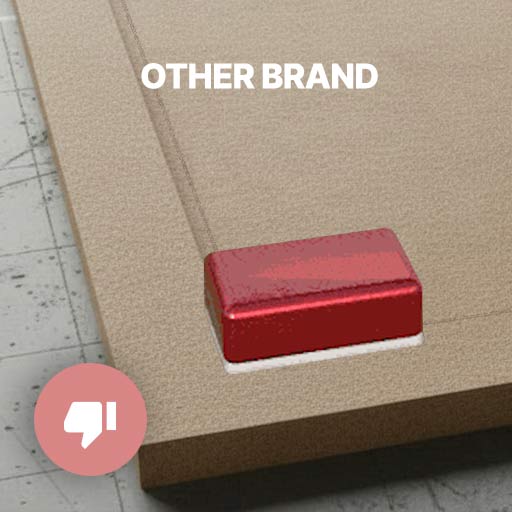
They apply uniform force
They aggressively over-sand or under-sand areas that are slightly warped up or down, leaving toolmarks or burning through delicate surfaces like primer or lacquer.
To actually eliminate manual rework, a system must be able to adapt to the physical 3D geometry of the door in real-time.
The Cabinet Door Automation Matrix
When evaluating sanding machines, you must look beyond cycle times and ask: “Can this system remove tool marks without damaging my door profile or requiring my operator to sort batches?”
Manual Sanding
Traditional Robotic
Industry Leader
Omnirobotic
3D AI & Force Control
Tool Mark Removal
Variable (Fatigue-dependent)
Often incomplete (stays away from inside profile)
Complete (0.1 mm accuracy from inside profile, Automatic Pitch Control and Active Force Control)
Profile & Edge Safety
Skill-based
High risk of over-sanding if misaligned or over pressured
Perfect (Automatic Pitch Control and Active Force Control)
Mixed Door Styles
Flexible, but labor-heavy
Requires strict sorting and new recipes
True Random Loading. (Mix styles freely)
Door Material and geometry
Flexible, but labor-heavy
Limited. Suctions cups, required perfect 4 corners flat. Hardwood and warped door will not work
Flexible. High flow vacuum table work with any material and geometry
Rework Risk
Medium to High
Medium
Near Zero
Best Use Case
Small, custom touch-ups
Long runs of identical doors
High-mix Shaker, Raised and Slab Panels
The Traditional Robotics Trap
Traditional robotic sanding relies on fixed programs, predefined paths, manual setup per part and perfect part alignment in jigs. This creates massive friction in real-world production. Parts must be sorted, operators must manually select touchscreen recipes, and any variation brings the machine to a halt.
What High-Mix Sanding Actually Requires:
Instead of relying on rigid code, the Omnirobotic PSA-80 PRO uses real-time 3D AI vision. You do not need to sort your doors. They can be placed anywhere on the table, in any orientation. The 3D cameras instantly detect the part orientation, map the multi-level depth of a raised panel or the crisp inside corner of a shaker, apply the correct dynamic sanding pressure, and remove CNC micro-lines right up to the edge without altering the geometry.
What Changes in Your Daily Production?
When you eliminate the need for batch sorting and manual programming, your entire shop floor accelerates.
Instead of managing each part manually, your operation becomes predictable, scalable, and highly profitable.
Continuous Production Flow
Doors move smoothly from the CNC, to the sander, to the finishing room without stop-and-go loading interruptions.
Less Operator Decision-Making
The AI removes the guesswork. You get perfect, consistent finishing prep regardless of who is working that shift.
True Labor Reallocation
Your operator drops a random mix of doors on the table, presses start, and walks away. They now have the freedom to manage final assembly, edgebanding, or quality control.
FAQ: Cabinet Door Sanding Automation
Can the system sand shaker doors without rounding off the crisp edges?
Yes. Traditional robots and wide-belt sanders often destroy delicate shaker profiles because they apply uniform, rigid pressure. The Omnirobotic PSA-80 PRO uses advanced 3D vision to map the exact geometry of the door with 0.1 mm precision. This allows it to perfectly sand the center panel and inside corners without ever rounding over your crisp profiles.
How does it handle the complex contours of raised panel doors?
Unlike traditional robots that rely on flat, 2D paths, our system uses real-time 3D AI vision to map depth variation on the fly. It physically “sees” the sloping contours of a raised panel and dynamically adjusts its active force compensation. This ensures consistent pressure across the entire multi-level surface, removing CNC tool marks without crushing the profile.
Do we need to sort our doors by size or style before loading the machine?
Absolutely not. Sorting batches is a hidden labor cost in traditional robotics. With our system, you achieve True Random Loading. Your operator can drop a completely random mix of shaker doors, raised panels, and flat drawer fronts onto the table in any orientation. The AI adapts to each unique shape instantly, requiring zero programming or recipe selection.
Will this machine actually remove CNC tool marks?
Yes. Unlike brush sanders that simply polish over micro-lines, our autonomous robotic arm applies targeted sanding pressure, exactly like a skilled human hand. It sand the doors and deliver adequate sanding power to each door section, entirely removing CNC machine marks and leaving a flawless surface ready for primer or thermofoil.
Does the robot sand the outer edges of the cabinet doors?
The PSA-80 PRO is purpose-built for the hardest parts of the job: faces and inside profiles. For edge sanding and corner breaking, a dedicated Edge Sander is simply more cost-effective. With the ability to utilize five sanding heads simultaneously, these machines outpace robotic arms by 500% while requiring a much lower investment. We’ve seen many shops abandon robotic edge-sanding options because they slow down the entire cell. We believe in providing the right tool for the right task. The Bottom Line: A machine designed to do everything often excels at nothing. By pairing the PSA-80 PRO with dedicated edge-sanding technology, you ensure every surface receives the highest quality finish without sacrificing speed.
Take Your Sanding Process to the Next Level
Tell us what you’re sanding, and we’ll show you how the PSA-80 PRO gets it done.
Autonomous Robots.
Trusted by Industry Leaders.

Resources
Contact Us
- © Omnirobotic Inc. 2026